May 30, 2026
NDIS Changes: What They Mean for You (And What to Look for in a Provider)
The NDIS is changing.
Read More
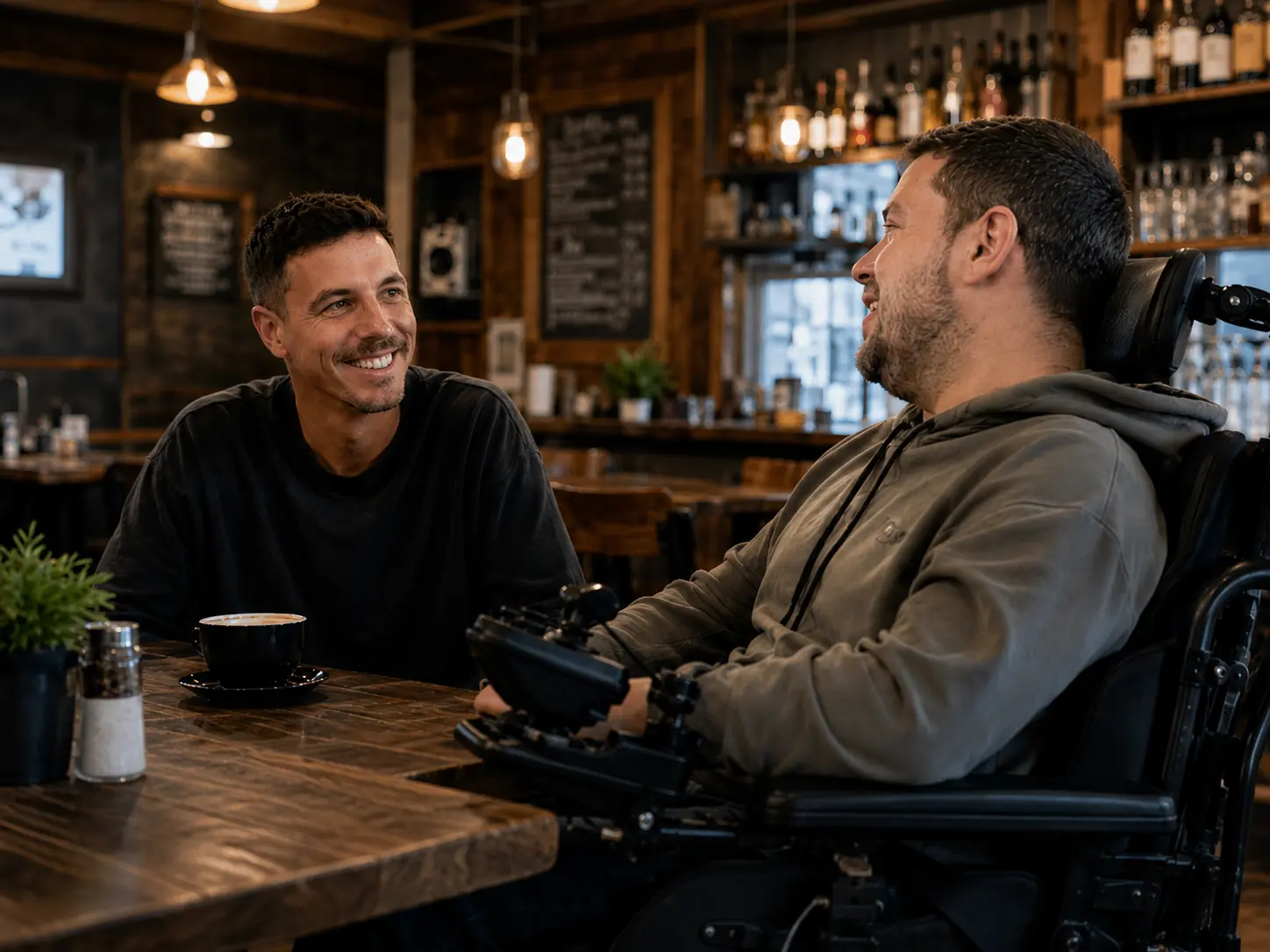
There is a big difference between good support and top tier support.
Good support shows up on time.
Good support completes documentation.
Good support works toward goals.
Good support complies with the NDIS Code of Conduct and gets through audits.
And to be clear — those things matter.
But for many men living with a traumatic injury or illness, “good support” still misses the most important part:
The human side of things.
When someone goes through a spinal cord injury, stroke, neurological condition, or another life-changing illness or accident, the physical side is only part of the story.
Hospitals focus heavily on physical recovery:
mobility,
transfers,
therapy,
equipment,
medication,
rehabilitation.
All important things.
But often, the emotional side of rebuilding a life quietly gets pushed into the background.
And honestly?
That is usually the hardest part.
Learning how to live in a completely different reality.
Losing independence.
Feeling isolated.
Feeling frustrated.
Feeling angry.
Feeling like life has become smaller overnight.
Then comes the NDIS.
You receive a participant number.
A plan.
Funding categories.
Goals.
Reviews.
Reports.
Assessments.
Sometimes, it can start to feel like life has become paperwork.
Like you are constantly trying to prove:
what you cannot do,
why support matters,
and why funding is still necessary.
That process can feel exhausting.
And while the NDIS absolutely plays an important role in helping people access support, it is also very easy for human beings to start feeling like numbers inside systems.
That is where support workers have the opportunity to make a real difference.
Top tier support is not just about completing tasks.
It is about understanding that behind every shift note, report, therapy session, and funding review… there is a real human being trying to rebuild a life.
Some days someone might feel motivated, driven, and ready to take on the world.
Other days, they might not want to get out of bed.
Some days they may feel proud of the progress they are making.
Other days they may quietly grieve the life they had before their injury or illness.
That emotional side does not disappear simply because someone has a support plan.
And this is where support can either stay “good”…
or become something far more meaningful.
Top tier support understands that we are not just showing up to perform tasks.
We are showing up to interact with another human being.
Sometimes that means:
having a laugh,
having a real conversation,
sitting quietly,
listening without judgement,
offering encouragement,
giving someone space,
or simply treating someone like a normal bloke instead of a participant number.
Because the reality is:
many men struggle to openly talk about what they are going through.
Even with the people closest to them.
People often ask:
“How are you going?”
But many are not prepared for the honest answer:
“Honestly mate, I’m not okay today.”
Top tier support creates an environment where someone feels safe enough to say that.
Not because support workers replace psychologists, therapists, partners, or family members.
But because genuine human connection matters.
There is something incredibly powerful about feeling like you are talking to someone who sees you as a person first — not a diagnosis, a task list, or a funding package.
At Blokes Care, we believe professionalism and human connection should go hand in hand.
Yes, documentation matters.
Yes, goals matter.
Yes, compliance matters.
But if support loses the human element, then something important gets left behind.
For us, good support simply is not good enough.
We believe support should feel:
human,
real,
honest,
and grounded.
Because sometimes the most important thing a support worker can provide is not just physical support.
Sometimes it is reminding someone that they are still themselves underneath everything they have been through.
That it is okay to feel frustrated.
Okay to feel angry.
Okay to feel lost sometimes.
Okay to admit that things are hard.
And most importantly:
Okay to talk about it.
Not as a participant number.
Not as a diagnosis.
Not as a funding package.
Just as another human being trying to rebuild a life after it has been turned upside down.
That is the standard we hold ourselves to.
Because at Blokes Care, top tier support is the only acceptable level of care.